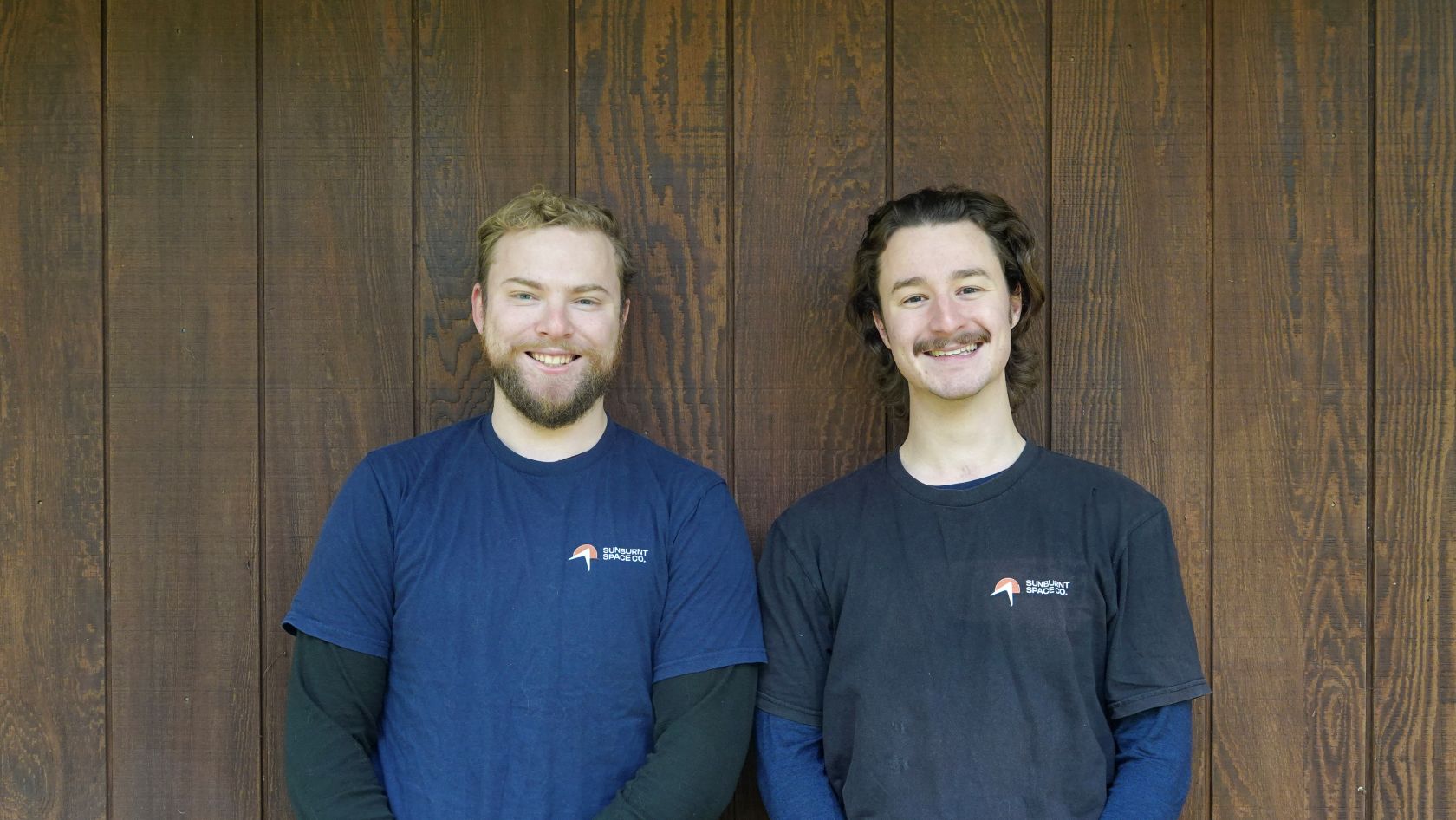


Founders: Lachlan Bramble, Ronan Kohlhoff
At age 13, Lachlan Bramble built a $12 model rocket kit with his dad. There was no rhyme or reason to it. He simply saw it at a hobby store in QVB Sydney, admiring its design and obvious 'coolness'. Almost a decade later, he's building reusable rockets for routine satellite orbital access with his co-founder Ronan Kohlhoff. Antares Aerospace is built by a team deeply fascinated with space. Lachlan's Zoom background is mostly stacks of engineering textbooks he read in high school. Most of his schooldays were spent learning how to build rockets. Lachlan met Ronan at university where they spent most of their time together building model scale rockets as part of the UNSW rocketry team. When other team members were solely focused on doing well in student competitions, these two were obsessing over space shots (a space shot primarily refers to the launch of a spacecraft or rocket beyond Earth's atmosphere).
Two ambitious students obsessed with the same goal found each other like moths drawn to a flame. They wanted to fuel Australia’s efforts for space travel. Lachlan had already spent two years in the UNSW rocketry team before Ronan joined, but says even from day one, Ronan was the most inquisitive of the new recruits. Ronan was almost too curious for his own good and Lachlan loved any conversation even remotely connected to space. They developed this almost mentor/mentee relationship pretty quickly. Eventually, the writing on the wall became too clear to ignore. Ronan developed his engineering skills to the highest level, and together they felt both a partnership and friendship had become their precursor to build a space company.
Australia is geographically primed for space launches. We're surrounded by sea, and we have land that stretches wide in both latitude and longitude. These are favourable conditions to produce launches at scale with the right infrastructure. It's no secret however that Australia is culturally risk-averse. As a nation we admire the agency of our competitors in America yet lack the bravery to capitalise on our advantages. Antares Aerospace is a prime example of unyielding conviction to press forward regardless of the obstacles at play. Lachlan sees Australia as advantageous with Australian aerospace companies being significantly more capital-efficient than US counterparts. We have the scrappiness and freedom from institutionalised thinking, nimble enough to serve smaller customers that big players no longer care about, and of course have the structural land advantages to make use of local deployments. There is a winning edge here for those who are brave enough to find it. Antares is proving that thesis.
What started out as in-space mobility, rocket engines designed to help satellites maneuver better in space, eventually revealed a massive bottleneck for assets in orbit. It became increasingly apparent that launch was still one of those areas of space where technology wasn't developing fast enough, unless you're the largest player with their own infrastructure in place. Lachlan and Ronan spoke to early employees in companies like SpaceX and Rocket Lab where experts were telling them that launch was still a very constrained market. This was particularly concerning, as almost 90% of what's actually getting launched is small satellites, which lack their own launch capabilities. Most of these satellites wouldn't even get the option to fly their own dedicated missions due to lack of support, infrastructure and budget to launch. It was an incredibly high barrier to entry. If a player can give power back to these small teams of 5-100 who are making massive strides in frontier space hardware, what can be done in space increases exponentially. “There's an OpenAI moment for space hardware where someone develops something new and revolutionary,” says Lachlan. Antares is on track to open that new frontier, to create an entirely new market for these small teams, where the incumbents no longer care to tread.