

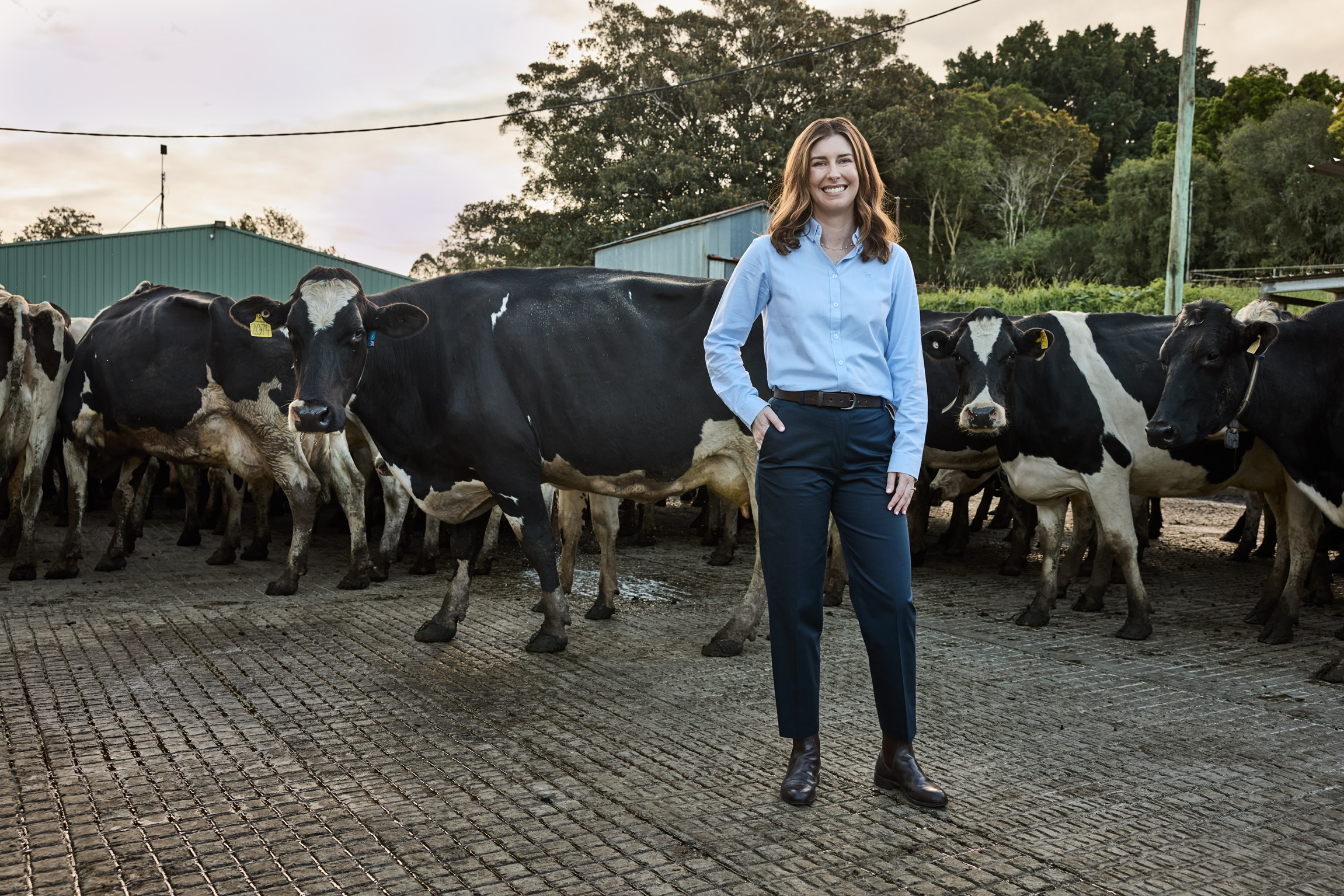
Laura Wedmaier is the Chief Financial Officer at Norco Cooperative, Australia’s last 100% farmer-owned dairy cooperative. With a career spanning global FMCG with Coca-Cola, IT, education and environmental infrastructure, Laura has worked inside organisations that are more than a century old.
Through First Believers, our angel investing program, Laura stepped into a new arena: early-stage investing. What followed was less about abandoning the spreadsheet and more about expanding how she thinks about risk, value and progress.
At the end of 2025, I had the pleasure of sitting down with Laura after she completed our investor program. Together, we stepped into the world of agriculture, exploring how her world-class experience as a CFO has shaped her evolving investment framework and how she brought that depth of perspective into Cohort 10.
From IT to CFO: building systems that scale ⚒️
Bell: Your career path is so diverse. How did you end up as CFO at Norco?
Laura: I started my career actually in IT. I studied IT at university and then went into management consulting. The first project I worked on was a big business transformation project in fast-moving consumer goods, and I worked really closely with the finance team there.
The client invited me to join them and the CFO at the time said, “I think you’d be great in accounting.” So I kind of retrained and went down that path. But I always wanted to work closely with the business, which was my interest in finance.
Starting in IT, I’ve always had this bent for doing system transformations in my finance roles, which has been super helpful. That’s why now I’ve got IT and finance in my team, which not all CFOs have.
Best practice vs best fit in growing organisations 🪴
Bell: You’ve worked in both global corporations and smaller organisations. What perspective has that given you?
Laura: Working in large multinational organisations gives you this perspective of what best practice and good looks like, because I’ve seen it at absolute global scale in terms of systems and processes.
Then I’ve also seen what under-resourced looks like, being in a smaller organisation where you’re putting processes in place and having to make trade-off decisions more so than what you have to in a big organisation.
Particularly as a finance person or a CFO, sometimes you can want all these controls. But you really need to be practical about the resources you’ve got and put it in a way that’s going to accelerate the business forward.
Best practice is not always the way that’s actually best fit for the size or stage that a company’s at.
Why a CFO from century-old organisations leaned into startups 🚀
Bell: What drew you to First Believers?
Laura: Pretty much every company I’ve worked for, I think except for one, is more than 100 years old. So I’ve worked for very mature, established organisations.
Part of it was curiosity, to get closer to innovative startup companies and learn more about what’s going on.
I did a program at Stanford University this year and they’ve obviously got a huge startup culture in Silicon Valley and California. I met a lot of people involved in the ecosystem and thought, I really want to get closer to this in Australia when I come home.
But I could also see that there was this big gap between people involved in startups and their understanding of mature businesses that they were trying to sell to. There is just this big gap between us, but we need to work together.
Startups are going to be much more successful if they’ve got a better understanding of mature businesses, and mature businesses have a lot to learn from startups. We can be more agile as well.
Capital, cycles and conviction in agriculture 🐄
Bell: From your perspective in dairy, what should founders understand about selling into agriculture?
Laura: Farming and agriculture is very cyclical. It can depend on the stage or the season we’re in.
Farmers really understand their cost base really well. So if they’re being asked to invest in something, they know the upfront cost, but it’s uncertain benefits. It’s a certain outflow of upfront they’ve got to pay X amount. That’s something they need to consider.
Agriculture is very personal. It’s like a family farm. It directly impacts you. So decision-making can be quite different to corporate. And it’s a smaller pool of capital as well for them to decide, “okay, I’m going to invest in this or invest in something else”.
If startups are selling into agriculture, de-risking that upfront investment, or having some kind of guarantee around the benefits, or making it really clear what those benefits are, can make people more likely to take a risk.
But in my experience with our farmers, they’re really interested in innovation. If there’s something that’s going to make their farm more efficient, they will listen and they’re curious about that.
When something works, adoption can be quite rapid. It’s just that proof point of de-risking that upfront investment, especially with seasonality and weather that can’t be controlled. But if it works, adoption can be quite quick once it’s proven.
Valuing progress over precision in investment decisions ⚖️
Bell: You mentioned you've now made your first investment. What was that experience like?
Laura: I didn’t know if my risk appetite would stretch to startups, but now I have invested. Even that has given me a lot of confidence about how do you assess value.
It’s not numbers, which is very hard for a CFO. I’m like, what do you mean I’m going to make an investment decision, but I don’t have a robust financial model? It does not compute.
Numbers are important, right. If it’s not a big enough idea or you can’t see how it can be commercialised. But the Startmate spikes around the team was a big aha moment for me.
If you can see someone with hustle and resilience and willingness to keep going, even if this isn’t the idea they ultimately land on, they’re the person that will take something like this forward.
At Stanford we learned that most decisions, like 80 to 90% of decisions, are actually gut feel. We’re taught not to make emotional decisions. We’re taught to use numbers, and again as a CFO I love the numbers, love data-driven decisions, but it’s actually not how we make decisions.
This brought together what I’d learned overseas with how angel investors and venture capitalists make early-stage investments. It’s about the individual and how much progress they can make.
It’s even changed how I assess projects internally. If I can see that someone really believes in it and they’re making progress every week, I can see potential behind it. Previously, I might have just asked, where’s the spreadsheet? Now I can assess progress through a different lens.
A daily reset for sharper decisions 🌅
Bell: As a CFO, life is busy. What’s a weekly ritual that brings you joy?
Laura: I’ve been doing daily meditation and breath work for almost six months now. It’s been a game changer for me.
I use the Headspace app for at least five minutes, and then I do three to five minutes of breath work separately from that. It really helps build resilience.
If I’ve got an important decision, I try to schedule it in the morning after I’ve done my routine because that’s when I’m at my peak.
If something important comes up in the afternoon, it only takes a minute or two and you can really re-elevate yourself to a higher performance state.
I’ve been monitoring my heart rate variability with my Whoop as well. I don’t always make it every day, but I try to be consistent.
Early-stage investing needs operators who understand systems, capital and scale. If you’ve built that experience, First Believers is where you learn to deploy it.
Join us in the next cohort.